How to do a brain dump that turns into a plan
A brain dump is a list of everything on your mind, written down without sorting. To turn it into a plan, pick one thing for today, give a few others a day, and let the rest wait where you can find it.
You need a pen and paper, or any notes app, and about 10 minutes. If you’d like a page that’s already laid out, the free brain dump template has a space for each step below.
Why writing it down helps
Most of us can actively juggle only about three to five things at once (Cowan 2001). Everything else has to be remembered, and unfinished things tend to come back to mind while you’re doing something else.
Writing them down is the start, but it isn’t the whole fix. In a set of experiments, unfinished goals kept intruding on an unrelated task until people made a specific plan for them (Masicampo & Baumeister 2011). And writing things down frees up memory only when people trust they’ll find them again (Storm & Stone 2015).
So a brain dump works best with two small additions: a choice about what happens next, and one place where the list lives.
How to do a brain dump, step by step
These steps work on paper, in a notes app or on the template. Nothing here needs a special tool.
1. Set a timer for 10 minutes
A limit keeps the dump from turning into a project. If you’re still going when it rings, finish the thought you’re on. If you need longer, take it.
2. Write each thought on its own line, and don’t sort yet
Tasks, worries, ideas, errands, a name you need to remember: all of it goes in the same place, in the order it arrives. Don’t decide where things belong while you write.
Sorting is real work in itself. In a classic study of office desks, people kept unsorted piles because deciding where each thing goes is hard (Malone 1983). A list you can see is far easier to sort than one still in your head.
3. When you stall, go through a few prompts
Ideas tend to come in clusters: a run of related thoughts, then a jump to a new topic (Hills, Jones & Todd 2012). When one run dries up, a new prompt can start the next. Try these, one at a time:
- work, school or the project you care about most;
- home, errands and things to buy;
- people: replies you owe, plans, birthdays;
- money, forms and appointments;
- things you’ve promised, and things you’re waiting on;
- ideas you’d like to keep, even if you never act on them.
4. Read the list once, slowly
Cross out anything that’s already done or no longer true. If two lines say the same thing, merge them. Don’t rank anything yet. This is just to see the whole list in one look.
5. Pick one thing for today
Just one. Choose what would make today lighter, or what has a real date attached, like a bill or an appointment. If the thing feels too big to start, make it smaller: “open the tax form” instead of “do taxes”.
One thing on today is a plan. If you finish it, pick another from the list.
6. Give a few things a day this week
Look for items that belong to a date: a call that has to happen before Friday, a form due on the 20th. Write the day beside each one, or put it in your calendar.
Only date what really has a date. Spreading the whole list across the week turns it back into something to keep up with.
7. Let some things go, and keep the rest where you’ll find it
Some lines are wishes rather than tasks. Crossing one out is a decision, and it’s allowed. Everything left stays on the list, unsorted, in one place you’ll look at again. That is what lets your head stop holding it.
A short example
Here is what a small dump might look like, before any sorting:
- reply to Sam about Saturday
- car insurance renews on the 28th
- finish the slides for Thursday
- learn to make sourdough
- book the dentist
- back up the laptop
- gift idea for Ana: the blue notebook
And the plan that comes out of it:
- Today: finish the slides for Thursday.
- Later this week: reply to Sam on Wednesday; book the dentist and check the car insurance on Friday.
- Let go, for now: learn to make sourdough.
- Still on the list: back up the laptop, and the gift idea for Ana.
Nothing on that list was lost. Two things simply don’t have a day yet.
Coming back to the list
Tomorrow, read the list, cross out what’s done and pick one thing again. It takes a minute or two once the first dump is done.
If a few days go by without a look, that’s normal. Start from today: pick one thing and leave the rest where it is. A fresh start, like a new week, month or term, is a good moment for a full dump. In field data, people were more likely to act on their goals at moments like these (Dai, Milkman & Riis 2014).
When it doesn’t feel like it’s working
The list is very long. That’s usual for a first dump. Length isn’t the problem; choosing is. Pick one thing anyway, and let the list be long.
Everything feels urgent. Look for real dates set by someone else: a bill, a deadline, an appointment. Those get a day first. Most of the rest can wait.
You wrote it all down and still feel stuck. Make today’s one thing smaller, until starting it takes a couple of minutes.
The same steps in Bloomingo
In Bloomingo, the first step is the braindump: one board with no date, for everything on your mind. Double-click anywhere on it to add a thought, and new thoughts line up in a loose grid so the board stays readable. You don’t choose where anything goes while you write.
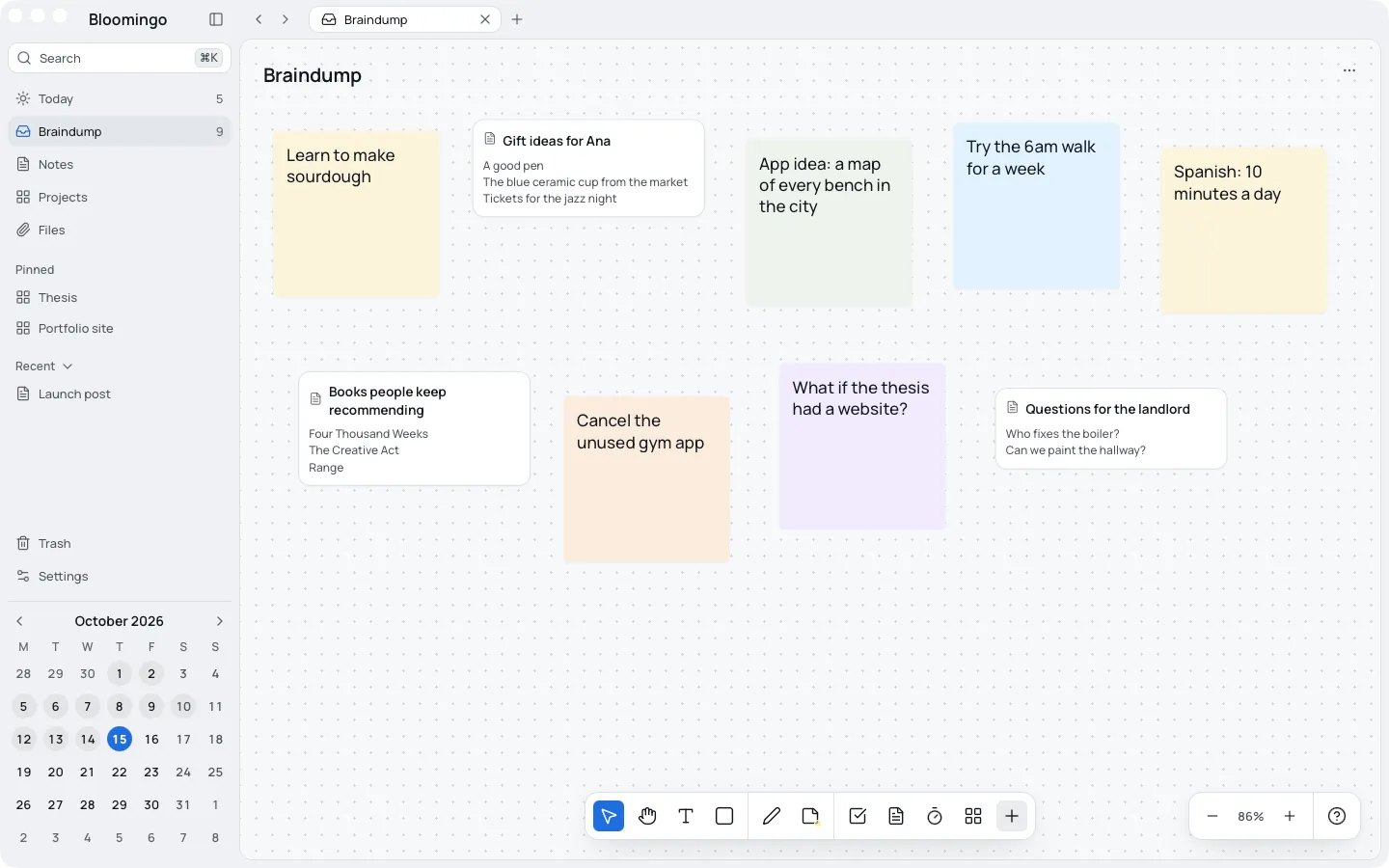
When you’re ready, give a thought a day, move it to a project, or leave it where it is. Every date in Bloomingo opens its own board, so today’s one thing sits on today’s board, with room for notes beside it. Each new day, yesterday’s unfinished tasks wait in a small tray: keep them for today, move them, or let them go. Thoughts you haven’t opened for weeks fade, and Bloomingo never deletes them.
Bloomingo isn’t out yet. It’s coming to Mac, Windows, iPad, iPhone and Android. You can read more about how the braindump works.
Get the free template
The brain dump template is one A4 page with a space for each part: everything on your mind, today’s one thing, later this week, and let go. Print it, or fill it in on a tablet. It’s free, and there’s no email to give.